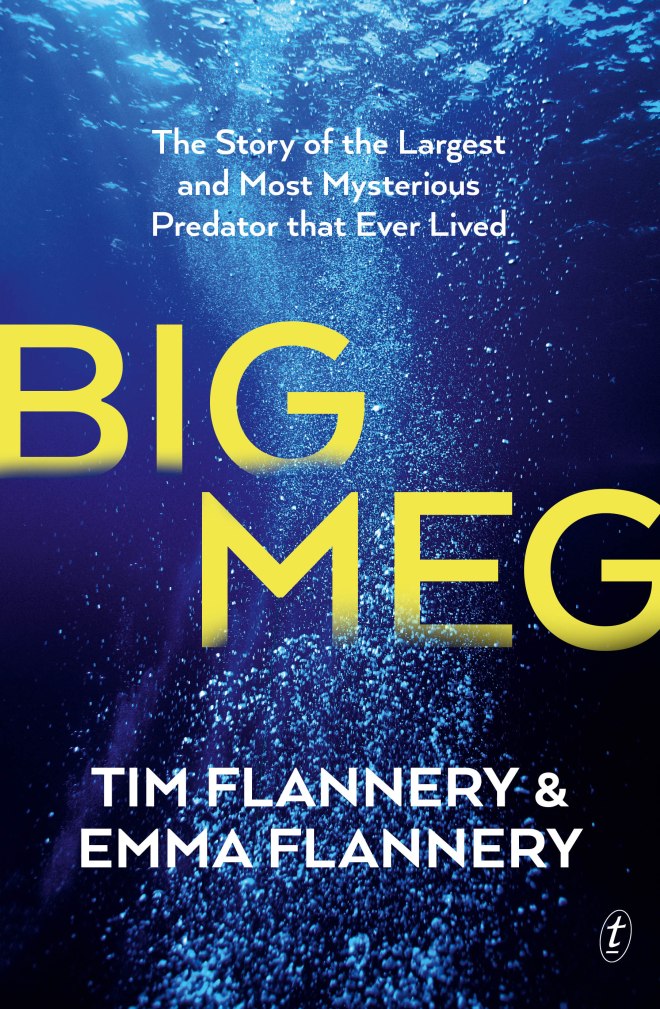
Recommendation: Tim Flannery on Megalodon… sign me up
Read with: A glass of Serafino Wines “Sharktooth” Chardonnay
In brief: Theoretically this is about Megalodon but it really is a love letter to palaeontology and a discussion about how the ancient past still shapes the modern world. It is also very short, so the $5 I spent on the iPad version was about the right price.
Tim Flannery is rightly Australian-famous for quite learned works (most notably his work on climate change) so you can imagine my surprise when this popped up in my Apple Books recommendations. One does not expect Tim Flannery and Jason Statham to tread the same ground, after all. His daughter Emma is his co-author on this and she is a noted science communicator and scientist in her own right, and one suspects she may have facilitated or encouraged this sort of approachable work.
The Flannerys open, not with the spectre of a giant prehistoric shark haunting the ocean preying on cruise liners, but with a story about Flannery Snr’s diving adventures as a young man. He was looking for seal fossils but as a little bonus, he found a large and very well-preserved megalodon tooth. Enchanted, he agonised over whether to hand it to his boss at the museum, or to keep it and say no more about it to anyone. His conscience won out and he duly passed it on to the museum along with the fossilised seal skeletons.
They then pivot to a couple of chapters on the life and times of the Megalodon and their evolution and the evolution of their (surprisingly distant) relative, the great white shark.
Because this is not really a book about Megalodon as was, they then take us straight back to archeology with a discussion about archeological sites and the best places to find Megalodon teeth (and some of the export restrictions, so don’t get too excited). There are some pages pondering the source of our fascination with the Megalodon today in fiction (and on National Geographic…) and the modern statistics around shark attacks before the whole thing concludes with a discussion of how many sharks are being eaten by people. Spoiler alert, the statistics are heavily skewed in our favor.
It is undoubtedly a slim tome and there is not much in the way of lengthy scholarly engagement with the current debates about the Megalodon’s biology, feeding habits, body shape or similar but who cares. It’s a fun, engaging Trojan Horse masquerading as a book about a giant scary shark while selling the joys of exploration and discovery.
 Bookshelves & Bourbon