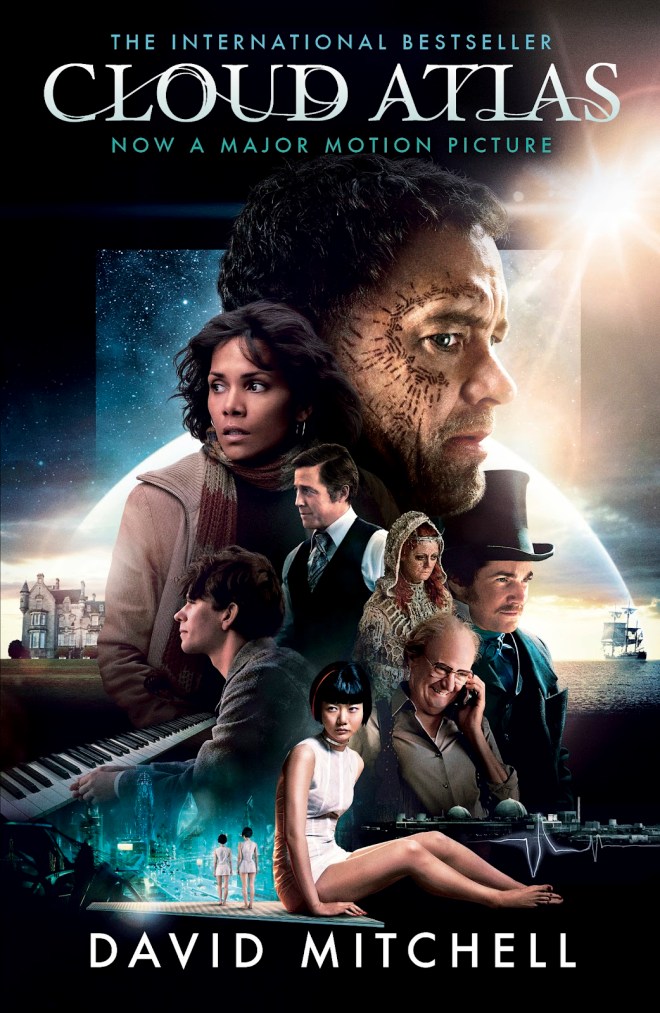
Recommendation: I loved this book when I first read it many years ago, and rereading was a reminder of why
Where to read: Winter cabin, somewhere in the Blue Mountains
Read with: The best deserves the best – a large glass of a good wine, drunk slowly
In brief: Cloud Atlas is a shimmering work of beauty, a truly impressive literary achievement and one of the best modern novels I have come across (honourable mentions also to Wolf Hall, The Overstory and a couple of others), although my somewhat limited fiction diet makes that less of a compliment than it could be. It is also completely bonkers, make of that what you will.
The controversial movie adaption aside (I loved it, personally), Cloud Atlas is a beautiful novel about love, tyranny, sacrifice, freedom and the costs and virtues of individual acts of resistance. It is also a masterclass in genre convention and playing with writing style.
Cloud Atlas consists of six separate and but connected stories. The first is the journal of an American lawyer voyaging the Pacific in the 1800s, the second a set of letters written by a young English composer who comes across the diary of said lawyer in the 1930s . The third is a pulpy murder novella set in 1970s California, the heroine of which encounters the aforementioned letters. Undermining the seriousness of the whole affair, the fourth section is a farce involving a 60-something English publisher set in the present day, which concludes with him speculating about publishing the novella (and his own memoir). Jumping (hopefully) well into the future, the fifth part is a record of interview conducted with a clone shortly before her execution by an oppressive corporate state and the sixth is a campfire story told after the end of the civilized world. Structurally, each but the sixth is split in half, with the first half of the first leading to the first half of the second and so on, moving forwards in time. The order then reverses, taking the reader backwards, step by step, until we finish where we began (terribly T.S. Eliot, I know).
This sounds like the recipe for a pretentious disaster however it is, in my humble opinion, nothing of the sort. For a start, the book is actually tremendously funny in a sly sort of way. Mitchell has a keen eye for the absurd and embraces every opportunity to satirise the excesses of his fellow artistic souls, the publishing industry, the reading public and capitalism as a whole (to name just a few). As mentioned, he even ventures into farcical slapstick in a fourth section which functions as the deep breath before the plunge into the darkness of the fifth and sixth sections.
Cloud Atlas is also interesting in the way it tacks between profound cynicism about human nature and cautious optimism about the impact of human choices. Throughout the novel, characters do appalling things in pursuit of power (and money) and abuse terribly the power they do wield in ways both petty and grotesquely evil. Many many others are passively complicit or morally corrupt. The main characters of each section, absurdly flawed as they sometimes are, fight against these tyrannies, suffering and often dying pointlessly – if, that is, you take each story on its own. In the context of the broader narratives, however, their choices and losses gain new significance. The testimony of the doomed clone, for example, is inspired by the movie adaption of the publisher’s memoir, and survives into a post-apocalyptic world where she is revered as a goddess. The impact of our lives and deaths, or so the novel suggests, ripple both forward and backwards beyond our lifetimes, and in inconceivable ways.
If the stories were not enough to hold your attention, Mitchell is also delivering a masterclass in literary style (and mimicry). Each section adopts a different form (diary, epistolary, interview, campfire story and so on) and genre, jumping from pulp thriller to science fiction with chameleon-like ease. The thematic and character links are clear, but each section is so distinctively crafted you could well forget they are all the work of the same author. It is seriously impressive work, and a bold choice given how important authorial voice and genre can be in branding (and selling the next novel).
In the end, I think Cloud Atlas was something of a victim of its own success – it was so hyped and so popular the sophisticates decided it could not possibly be high-brow fiction (they may also have taken umbrage at the image of a pretentious critic being thrown from a roof by a disgruntled author). There are certainly works that deserve this treatment (All the Light We Cannot See and The Alchemist spring to mind as particularly horrendous examples of that genre) but Cloud Atlas was not one of them. If you have yet to enjoy it, I commend it to you. If you read it 10 years ago and were contemplating a reread, you might be better served expanding your horizons, but you might also be missing out on some joy.
 Bookshelves & Bourbon